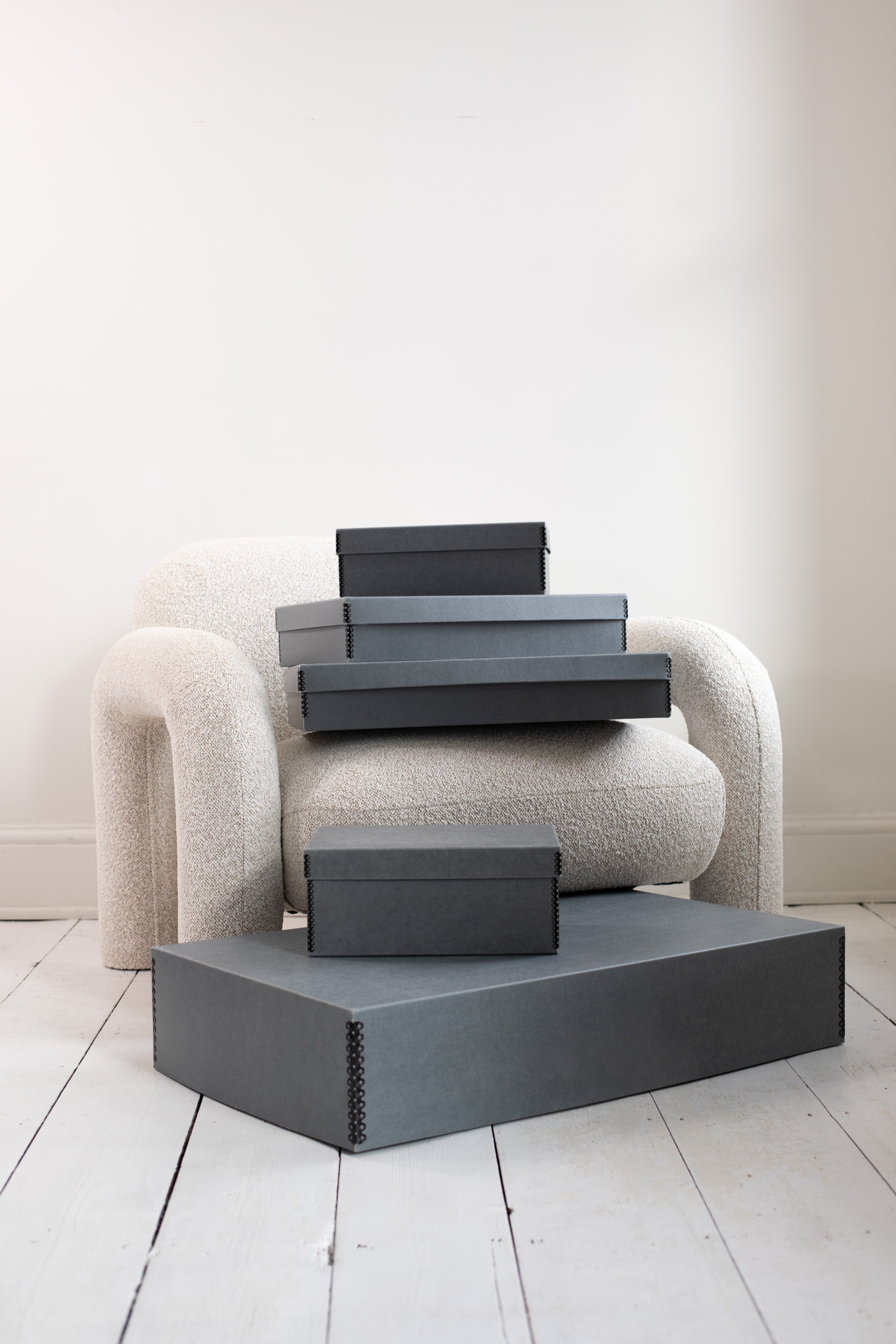

Most people think a storage box is a storage box. Slip the wedding dress into the prettiest one on the high street, tuck it into the loft, and hope for the best. Then you open it ten years later and the silk is yellow, the lace is brittle, and the bodice has a brown shadow exactly where the cardboard touched it. The box was the problem. This is the part of textile conservation almost no one explains properly — and it is the reason every box we sell is a very specific kind of box.
What you'll need
- Acid-free storage boxes — unbuffered, lignin-free, museum-grade boxes in dress, shoe, handbag and accessory sizes
- Acid-free unbuffered white tissue paper — for layering, padding and protecting between folds
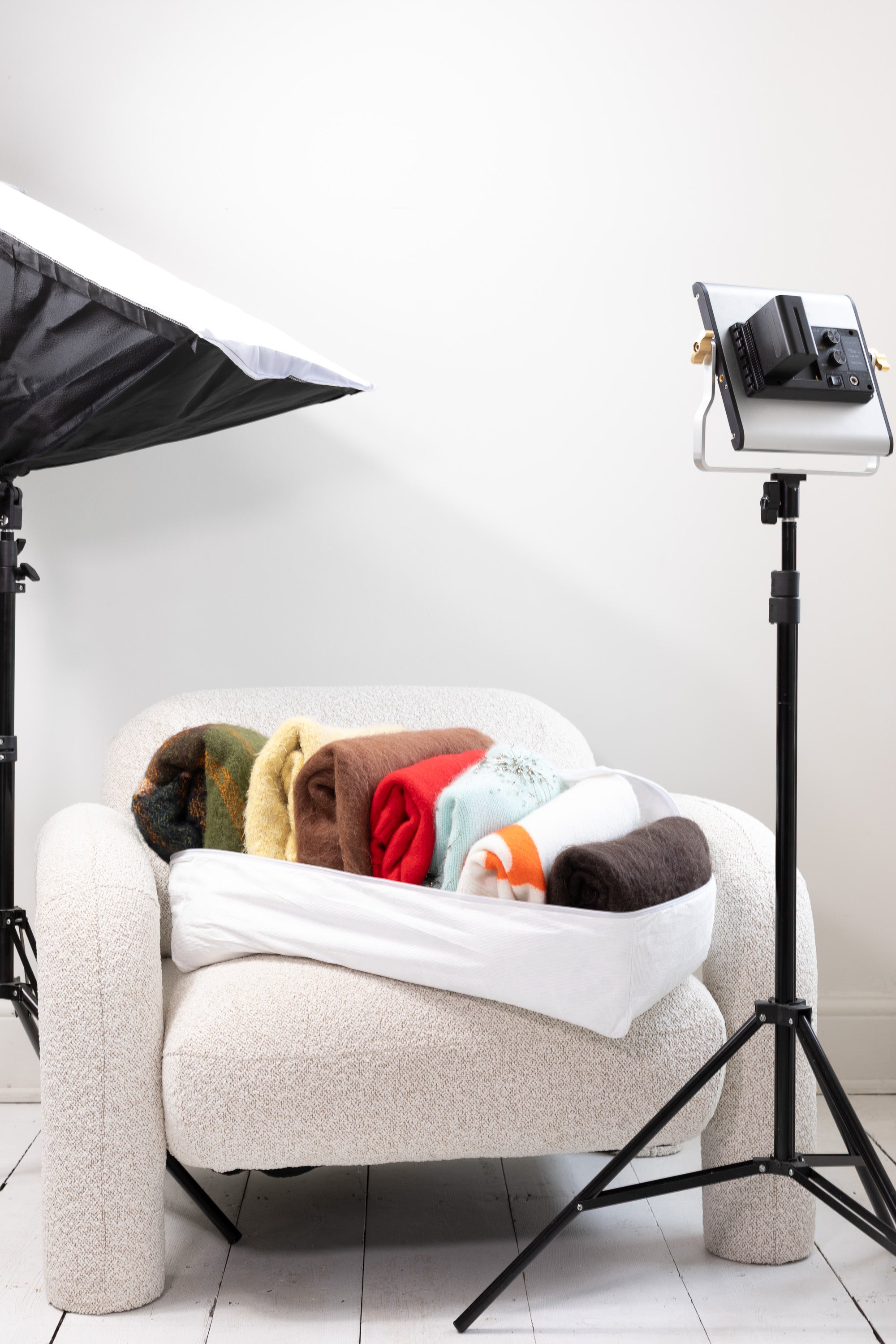
- Tyvek storage bags — the breathable companion for pieces you would rather not box
The reason ordinary cardboard ruins clothes
A standard cardboard box is made from wood pulp, and wood pulp is full of lignin — the natural compound that gives wood its rigidity. Lignin is also acidic, and it doesn't stay where you put it. Over months and years it slowly off-gasses and migrates outwards into anything in contact with the box: tissue, garments, leather, paper, photographs. The acid breaks down the long molecular chains in cellulose and protein fibres, and the visible result is the thing every conservator has seen a hundred times — yellowing, brittleness, brown contact marks where the fabric touched the board, and a chalky degradation along folds and edges.
It is slow. It is invisible for the first year or two. And by the time you can see the damage, it isn't reversible. The single most expensive piece of clothing many people own — a wedding dress, a vintage coat, a christening gown — is also the one most likely to be sitting in exactly the wrong kind of box.
What “acid-free” actually means
Acid-free is a manufacturing standard, not a marketing term. A genuine acid-free board is made from cellulose pulp that has been processed to remove lignin and any residual acids, leaving the finished material at a neutral pH (around 7) or slightly alkaline (around 8.5). The result is a board that doesn't release acid into its contents and doesn't degrade itself for decades. It is the same material used to house textile collections at the V&A, the National Trust, and every serious historic costume collection in the country.
The catch is that not every box marketed as “acid-free” is actually safe for clothing. Which brings us to the technical bit no one talks about.
Buffered vs unbuffered — and why we only sell unbuffered
This is the conservation rule almost every “acid-free wedding box” sold online gets wrong, and it is worth explaining properly.
When acid-free board and tissue is manufactured, the maker can add a small amount of calcium carbonate (chalk) to the pulp. This creates an alkaline reserve, raising the pH to around 8.5. Boards and papers with this reserve are called buffered, and the buffer acts as a sponge, soaking up any acids that migrate in from the surrounding environment over time.
For most paper-based items — photographs, newspapers, certificates, documents — buffered enclosures are excellent. But there is a critical exception, and it is exactly the kind of thing we store in wardrobes:
Protein fibres should not touch buffered materials. Silk, wool, cashmere, alpaca, fur, feathers and leather are all built from protein, and proteins are damaged by alkaline conditions just as they are by acidic ones. The chalk in a buffered box, over years of contact, can yellow silk, weaken wool, and stiffen leather. It is a slower kind of damage than acidic cardboard, but the same outcome: the box harming the garment it was meant to protect.
The same logic applies to dyed textiles of any fibre. Many natural and synthetic dyes are pH-sensitive, and a buffered enclosure can cause dyes to shift or fade over time.
Conservators handle this by using unbuffered, acid-free enclosures for all protein-based and dyed textiles. The board is still neutral pH — no acids leaching out — but it has no chalk in it either, so there is nothing to push the chemistry the other way. It is the safest possible environment for a wedding dress, a wool coat, a silk blouse, a pair of leather shoes, or any garment whose fibre type you are not entirely sure of.
This is why every acid-free storage box and every sheet of acid-free tissue we sell at Kept is unbuffered. It is a more expensive material to source. It is the only one we would put a piece we cared about into.
Why decorated “wedding boxes” are usually a step backwards
There is a whole category of pretty boxes sold for storing wedding dresses — silk-covered, lace-trimmed, ribbon-wrapped, sometimes printed with flowers or dates. They look lovely. Many are made from acid-free board, which the seller will tell you about. But the decorations introduce a problem the board has just solved.
Inks, dyes, glues, ribbons, lace and silk overlays are all potential sources of acid migration, off-gassing, and direct chemical contact with the dress. The whole point of an acid-free environment is that it is inert: nothing inside it is reacting with anything else. As soon as you decorate the box, you compromise that environment. A dress in a beautiful printed box may be in worse shape ten years on than the same dress in a plain white archival one.
Conservation boxes are deliberately undecorated, for the same reason a museum store cupboard isn't lined with wallpaper. The plainer, the safer.
Why we sell the sizes we sell
The other thing the high street gets wrong is sizing. A box that is too small forces a garment to crease tightly along permanent fold lines. A box that is too big lets the contents slide around and rub against themselves. Either creates damage. Conservators size storage to the object, with just enough room for tissue padding to support the natural shape.
The Kept range is built around the pieces people actually need to store at home, in the sizes that genuinely work:
- Wedding dress boxes — Standard, Large and Extra Large. Three depths and lengths, because wedding dresses vary so much. A simple slip dress needs a different box from a ballgown with a structured bodice. The larger sizes are deep enough to hold a properly tissue-padded train without flattening it.
- Veil & Accessories Box. A shallower, smaller box sized specifically for veils, headpieces, gloves and bridal jewellery — pieces that need their own space, not to be tucked into the corners of the dress box where tulle can snag and pearls can press into silk.
- Shoe boxes — mid-heel and high-heel depths. Two depths, because cramming a stiletto into a flat-shoe-sized box bends the shank and warps the heel over time. The high-heel box gives the shoe room to sit upright on its own foot bed.
- Handbag box. Sized for a structured handbag stuffed with acid-free tissue to hold its shape. Leather needs space, breathability, and an inert environment more than almost anything else in the wardrobe.
Every box is made with the conservation principle in mind: enough room for the object plus tissue padding, no decoration, no metal fasteners that could corrode, and a lid that fits properly so dust and pests stay out.
Why the box is only half the answer
Conservators never put a textile straight onto the base of a box. The standard practice is to layer and pad with acid-free tissue paper — and it has to be the same kind of tissue as the box: unbuffered, lignin-free, neutral pH.
The tissue does three things at once:
- It cushions folds. A soft sausage of crumpled tissue inside a fold prevents the sharp crease that, over years, becomes a permanent line and eventually a tear. Wedding dress bodices, silk gowns and beaded pieces all need this.
- It separates surfaces. Layers of tissue between folds stop fabric rubbing against itself and prevent dye transfer between contrasting elements.
- It buffers humidity. Tissue holds and releases moisture much more slowly than fabric, evening out the small fluctuations that cause fibres to shrink and swell over time.
Crucially: never use ordinary white tissue paper from a stationery shop. It is almost always acidic, often dyed, and the lignin content is the same as standard cardboard. It will damage the garment it was meant to protect, faster than no tissue at all.
How long does an acid-free box last?
A genuine unbuffered, lignin-free archival box, kept in a cool, dry, dark environment, has a working life measured in decades — fifty years and more in conservation collections. That is the design intent. The same box left in a damp loft or a sun-baked attic will fail much sooner, not because the board has degraded but because the environment around it has overwhelmed any storage system.
The right box, in the right place, is a one-time investment for the lifetime of the piece you are protecting.
The whole principle, in one paragraph
An acid-free storage box is doing one quiet job: providing a chemically inert environment in which a garment can sit for years without anything happening to it. The board has to be unbuffered (so the chalk doesn't damage the protein fibres). The tissue has to match the board (same chemistry, same neutrality). The box has to be undecorated (so no inks, dyes or glues compromise the environment). And the size has to fit the piece (so the garment isn't crushed or sliding). Get those four things right and the dress, the coat, the christening gown or the pair of vintage shoes will come out exactly as they went in.
Frequently asked questions
Why unbuffered specifically? Isn't more alkaline better?
Not for protein fibres. Silk, wool, cashmere, leather and feathers are all built from proteins that are damaged by alkaline conditions as well as acidic ones. Buffered (alkaline) enclosures are excellent for paper and photographs but slowly degrade animal-derived fibres over years of contact. Unbuffered, neutral pH is the safer default for any clothing or textile, and the only choice when the fibre content is mixed or unknown.
Can I reuse an acid-free box?
Yes — that is exactly what they are designed for. As long as the box hasn't become damp, contaminated, or had something acidic stored in it, the board stays neutral for decades. Replace the tissue paper between uses (it is the cheaper component and absorbs whatever the previous garment was carrying).
Are acid-free boxes waterproof?
No. They are paper-based, breathable, and designed for indoor storage in stable conditions. If you are worried about flood risk, store the box on a high shelf, not in a way that traps moisture against it.
Do I need to wrap the garment first, or can it touch the box directly?
Always layer with tissue. Even an unbuffered, undecorated box is better with a clean tissue layer between the board and the garment — it absorbs humidity fluctuations, prevents any incidental transfer, and lets you slide the garment in and out without dragging it on the base.
What's the difference between your boxes and the pretty wedding boxes I've seen elsewhere?
Ours have nothing on them. No lace, no ribbon, no silk overlay, no printed dates. Every decoration is a potential source of contamination, and the whole conservation principle of an acid-free box is that the environment inside stays inert. If it looks like something a museum would use, it probably is. If it looks like a present, it usually shouldn't be storing one.
Where should I keep an acid-free box?
Cool, dry, dark, with steady temperature. Bedroom wardrobe shelves, under the bed, or the top of a cupboard are all ideal. Avoid lofts (temperature swings cause condensation), basements (damp), garages, and direct sunlight (UV).
Buy the right box once, use it for fifty years, and open it on the day your daughter wants to try on the dress to find it exactly as it was. That is the whole conservation principle — and the reason we only sell the kind of box that does it.